

Skip to content

✌🏼 Free shipping on orders over $89!

Erasers for Drawing: How to Choose the Right Type and Fix Common Erasing Problems
Written by: The Art Noise Team

The Art Noise Team shares practical guides on art materials, studio workflow, and techniques, written for working artists and beginners alike. Our content is grounded in day-to-day conversations with artists in Kingston, Ontario, and focuses on helping you choose supplies with confidence.

Erasers are drawing tools, not just cleanup. This guide explains the main eraser types, how to match them to graphite and charcoal, and how to erase without roughing up your paper.
You will get a simple starter kit, a 30-minute practise plan, and troubleshooting fixes for common problems like smudges and “ghost” lines.

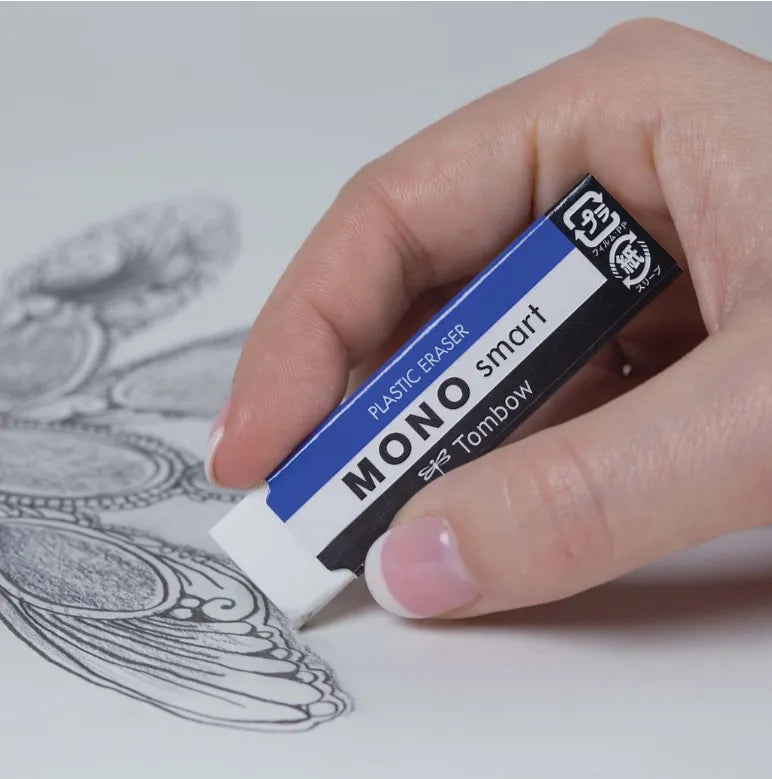
Tombow Mono Smart Eraser - Art Noise Tombow Mono Smart Eraser Tombow Erasers art-noise.myshopify.com tombow-mono-smart-eraser Tombow Mono Smart Eraser Tombow Erasers art-noise.myshopify.com tombow-mono-smart-eraser

Erasers for drawing, what they actually do (and why paper matters)

If you have ever “erased” a line and ended up with a grey haze, a smudge, or a rough patch of paper, you are not doing it wrong. Most erasing problems come from using the wrong eraser type, pressing too hard, or erasing on the wrong surface for the job.

Start by thinking of erasers in two categories. Some erasers lift pigment gently (great for charcoal and soft graphite). Others erase by gripping pigment more aggressively (great for crisp corrections, but easier to overdo on delicate paper).

Quick match guide

  • Soft graphite and charcoal: prioritize lifting first, then tidy edges later. Browse charcoal drawing supplies and graphite drawing supplies with this in mind.
  • Thin paper or smooth sketchbook pages: use a lighter-touch eraser and fewer passes, then stop. Over-erasing polishes the fibres and makes the area harder to re-draw.
  • Textured paper: erase with short strokes that follow the tooth, and clean crumbs often so you do not grind them in.
  • Tiny corrections (edges, highlights, lettering): use a precision eraser tip, or protect the surrounding area with a shield from drawing accessories.

If you want to shop by category while you read, you can browse erasers for drawing and build a small kit that matches your favourite medium and paper.

Shop Erasers

A simple eraser toolkit, plus a 30-minute practise plan
This is a practical setup that works for most creatives, from beginners to experienced sketchers. It is also easy to scale for a classroom, a studio, or a small “screen-free” drawing habit at home.

Desk checklist (keep this within reach)

Step-by-step: the “erase smarter” routine (30 minutes)

  1. Make a test strip (3 minutes). On scrap paper, draw five lines: HB (light), 2B (medium), 6B (dark), a shaded patch, and one charcoal mark if you use charcoal. You should see a clear range of values, from barely-there to very dark.
  2. Lift first (4 minutes). Press and lift with the kneaded eraser instead of rubbing, especially on the shaded patch. You should see the value lighten without the paper looking shiny; avoid scrubbing because it can flatten the tooth quickly.
  3. Erase once, then stop (5 minutes). Use the plastic eraser on the HB and 2B lines with a light pass, then check the surface at an angle. If the area looks slightly polished, stop and redraw, do not keep erasing.
  4. Clean crumbs immediately (2 minutes). Tap the paper gently so crumbs fall away, or sweep them off with your hand in one direction. Avoid brushing crumbs back and forth because they can smear graphite across the page.
  5. Sharpen an edge (6 minutes). Put the erasing shield down over a shaded area and erase a narrow highlight through one opening. You should see a crisp edge that looks intentional, not a fuzzy light patch.
  6. Fix a small mistake (5 minutes). Use the precision eraser pen to remove a tiny corner or a tangent line, then redraw that edge with a lighter touch. You should see a clean correction that does not look “overworked.”
  7. Do one final pass (5 minutes). Step back, then choose only one thing to correct, not everything. If you are practising with kids, use a simple script: “Light touch, one pass, check, then decide.”

Make it easier (for busy people, kids, and cramped desks)

  • Only have 10 minutes: do steps 1, 2, and 4, then draw for fun, corrections can wait.
  • Drawing with kids (ages 6+): keep the erasing shield and small eraser bits in adult hands, and use larger erasers to reduce choking risk.
  • Hate crumbs: erase over a second sheet of paper, then lift the whole sheet and dump crumbs in one move.
  • Delicate paper: switch from rubbing to press-and-lift for most corrections, then redraw lightly.
  • Left-handed or heavy smudger: place a clean scrap under your drawing hand and move it down as you work.
  • Budget constraint: start with one kneaded eraser and one plastic eraser, add the precision eraser later if you find yourself doing tiny edits often.
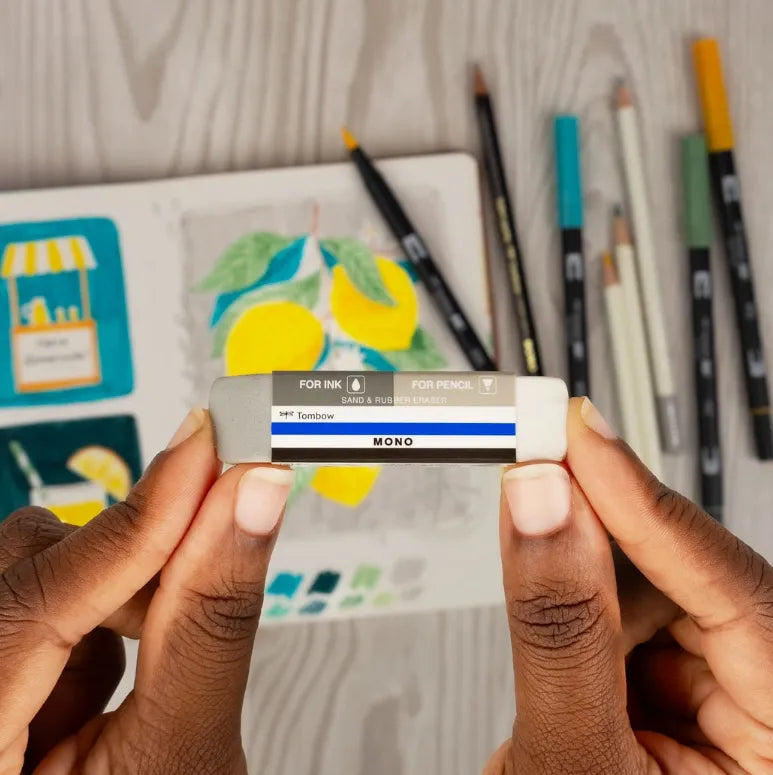
Tombow MONO Sand and Rubber Eraser - Art Noise Tombow MONO Sand and Rubber Eraser Tombow Erasers art-noise.myshopify.com tombow-mono-sand-and-rubber-eraser-1 Tombow MONO Sand and Rubber Eraser Tombow Erasers art-noise.myshopify.com tombow-mono-sand-and-rubber-eraser-1

Troubleshooting: common erasing problems and fast fixes

Use this section like a quick diagnostic. Pick the symptom, apply one fix, then return to drawing so you do not get stuck “polishing” the paper.

  • Problem: the paper looks shiny after erasing. Fix: stop erasing, redraw lightly on top, and switch to press-and-lift next time. A shiny patch usually means the fibres are being burnished.
  • Problem: grey haze remains after the line is gone (“ghost line”). Fix: lift with a kneaded eraser first, then do one light pass with a plastic eraser. You should see the haze fade without needing to scrub.
  • Problem: erasing creates a smudge streak. Fix: clear crumbs immediately, and put a scrap sheet under your hand. If the smudge is fresh, lift it with the kneaded eraser instead of rubbing.
  • Problem: the paper pills or tears. Fix: reduce pressure, reduce passes, and move to a slightly sturdier paper from paper and pads. Avoid “rapid-fire” rubbing because it is the fastest way to damage fibres.
  • Problem: charcoal will not erase cleanly. Fix: lift in layers (press and lift repeatedly), then accept a soft edge and redraw. Charcoal often behaves better with lifting than with aggressive erasing.
  • Problem: you erased the wrong edge. Fix: use an erasing shield next time, and practise covering the “keep” area first, then erasing only what is exposed.
  • Problem: highlights look too harsh. Fix: soften the highlight by shading back over it lightly, then lift again with a smaller touch. You should see a more natural transition instead of a bright stripe.
  • Problem: you keep erasing the same spot. Fix: set a rule, maximum two erases per area, then move on. If the drawing still feels off, change the value around the area rather than erasing the line itself.

What to buy for your medium (graphite, charcoal, and family drawing), plus a simple “today plan”

If you want a simple buying decision, match your eraser to your medium and your paper, then add precision tools only when you feel friction.

Graphite (HB to 6B)

  • Use a plastic eraser for crisp line removal, then redraw with a lighter touch.
  • Keep a kneaded eraser nearby for gentle lifting in shaded areas, so you can adjust values without stripping the paper.

Charcoal and very soft media

  • Prioritize lifting (press-and-lift) over rubbing, especially for highlights and soft transitions.
  • Use an erasing shield for clean edges when you need a sharp highlight or a controlled correction.

Drawing with kids and families (low mess, low frustration)

  • Choose larger, easy-to-grip erasers and keep small precision parts supervised.
  • If you are building a family kit, start in Kid's Drawing supplies, then add one “adult” precision eraser if the projects need fine control.

Your simple plan for today (15–25 minutes)

  1. Pick one page in your sketchbook and draw for 10 minutes with lighter pressure than usual.
  2. Correct only three things, using lift first, then erase once, then stop.
  3. Write one note on the page margin: what eraser worked best, and what paper reaction you saw.

If you want a technique refresher that pairs well with careful corrections, see our linework and blending guide. When you make cleaner marks up front, you will need fewer eraser passes later.